

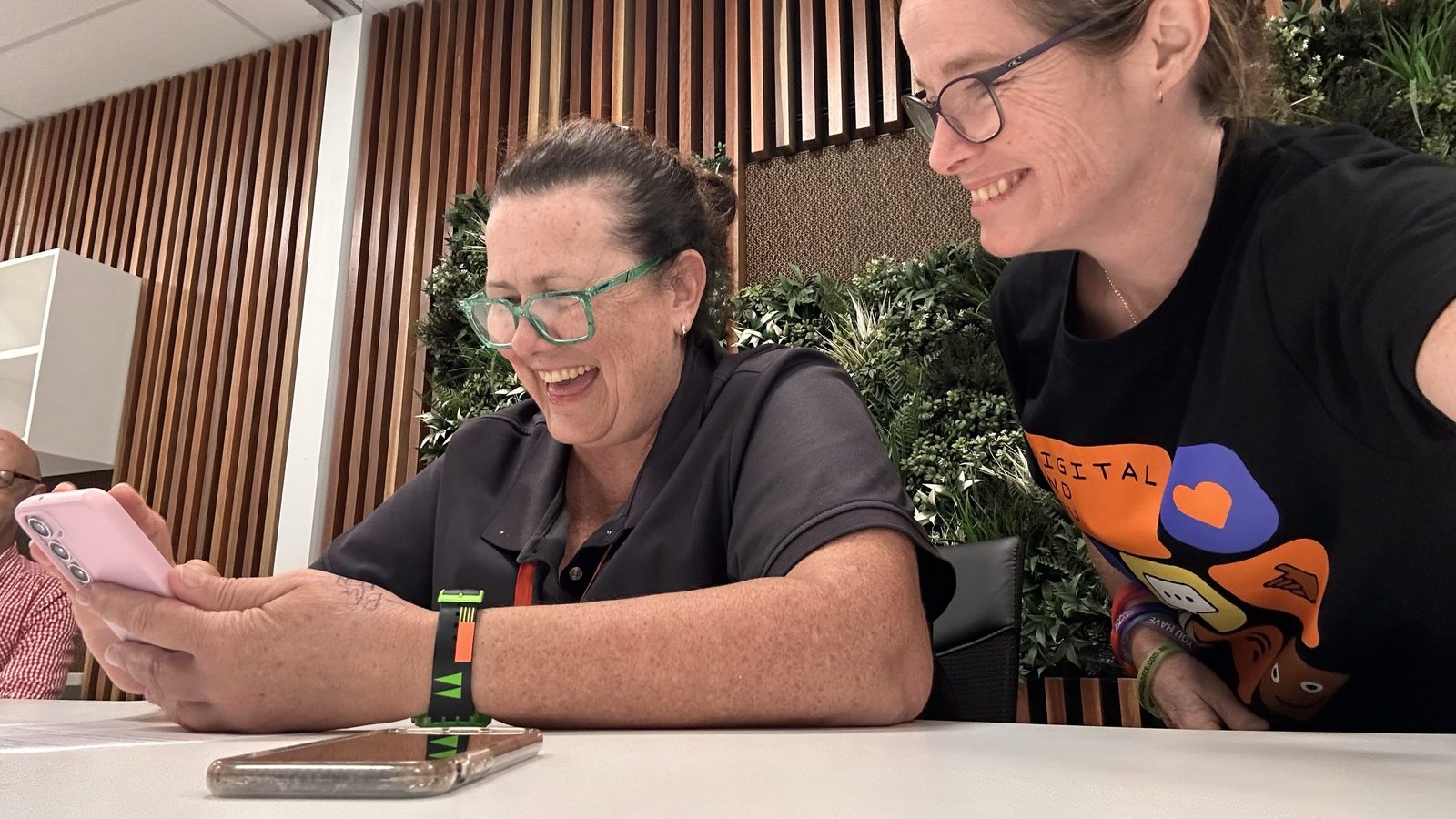
That photo was taken in Julia Creek in December 2024. I took it on my phone, in a workshop I was running, because she had been grinning at her own screen for twenty minutes. It later became the lead image on the State Library of Queensland's page about the programme.
On 30 June 2026, Queensland stopped funding the programme that had taken digital skills training into 48 regional, rural and remote councils. I taught on it. I want to tell you what it did first, because the gap it was closing has not gone anywhere.
This is not a complaint about a decision. Programmes end. It is an argument about what the evidence shows, made with somebody else's numbers, because those are the ones worth trusting.
First, the problem is real and it is measured
The Australian Digital Inclusion Index has measured this country's digital divide for ten years. It is run out of the ARC Centre of Excellence for Automated Decision-Making and Society with the Social Research Centre at ANU, partnered with Telstra. It scores three things: whether you can get online, whether you can afford it, and whether you know how.
Queensland sits below the national average on all of it. Not dramatically. Consistently.
The Index is blunt about why, and it is worth quoting because it is not a criticism, it is a description of the state: "Queensland's slightly lower scores reflect its decentralised population." Being spread out is the thing that does it. That is not a problem you fix from Brisbane.
Nationally, around one in five Australians are digitally excluded. Capital cities average 75.5 on the index. The rest of Australia averages 69.6. In very remote areas the score falls up to 11 points below the national average. And among Australians aged 75 and over, 66.5 per cent are digitally excluded, against a national figure of 20.6 per cent.
That last number is the one I think about, because those are the people in my rooms.
What Queensland did about it
Under Our Thriving Digital Future, the state's Digital Economy Strategy for 2023 to 2026, State Library of Queensland received $9 million to run four connected initiatives: $5 million to establish and equip Indigenous Knowledge Centres, $3.5 million to put Regional Digital Development Officers inside local libraries, and $500,000 for Deadly Digital Communities. The whole thing carried one public brand, Digital and You.
Then in 2026 they had it independently evaluated. Here is what the evaluation counted.
What it actually looked like in a room
Numbers like that flatten the thing out. So here is one participant, from a content creation workshop I ran in Mossman, quoted in State Library's own reflection on the programme:
"I was a little trepidatious as I am not comfortable on camera. Suzie was very personable and put us all at ease immediately. She was helpful with specific instructions and suggestions to improve content quality."
Participant, Mastering digital tools for content creation, Mossman. From State Library of Queensland's Digital and You reflection, June 2026.
Trepidatious. I love that word, and I think about that person often. They walked in dreading it and came anyway, which is the part that takes courage. It happens well before I have said anything useful about framing or lighting.
Nobody has ever left one of my workshops because the phone was too hard. The phone was never the hard part. What people are managing is being watched while they are not yet good at something, in a small town, by people they will see at the shops on Saturday.
The evaluation puts the stakes plainly for older people in regional towns, quoting one of the programme's own officers on what happens when the bank branch closes and everything moves to MyGov and telehealth:
"If they don't understand what they're doing, we're leaving them in a really vulnerable space, because they're sharing all of their logins with family members, and they don't actually know what's happening with their finances or their accounts."
Regional Digital Development Officer, State Library of Queensland. Evaluation, p48.
The same page describes how you teach it, and it is the best short description of this work I have read: "It's about taking it as slow as the slowest person. Once they get over that initial technological fear, they go, oh, this is actually really useful."
The finding I did not expect: AI was the way in
If you had asked me which sessions would do the heavy lifting for digital confidence, I would have said the basics. Setting up a phone. Recognising a scam. Those matter enormously and they filled rooms.
But the evaluation names something else, twice, in both its implications and its conclusion:
"Programs like Esports, digital storytelling, and AI for small business have demonstrated real power to build confidence and draw in participants."
Evaluation of State Library's Digital Inclusion Program, 2026, p50.
And a library staff member explains why, in a line that has changed how I pitch this work:
"Those small business workshops hit a lot of those people who work, who don't come into the library, but that got the momentum going as well for the library workshops."
Library staff member. Evaluation, p31.
Read that twice if you run a library or a council. The AI and small business sessions reached working-age people who never walk through the door, and that pulled momentum through to everything else the service ran. The thing that looks like the flashy add-on turned out to be the front door. If you are one of the people those small business sessions were built for, the version I teach in the room is written up in how to start using AI in your business.
It also matches what I see. In Mareeba, Kuranda, Dimbulah and Chillagoe the programme ran online safety, website development, artificial intelligence, videography and podcasting through the same libraries for the same communities. Not separate audiences. The same people, learning to tell their story and to run the business behind it.
That is the whole basis of how I work now, so I will say plainly that the evaluation validating it is convenient for me. It is also independent, and you can read it yourself, which is why I am pointing at it rather than asking you to take my word.
My part in it, properly sized
I was one of the external training providers on a four-part programme delivered by dozens of people. I ran the content creation workshops. State Library's own write-up puts it this way:
"Media trainer Suzie Cray from eMotion Video led the workshops in Cloncurry, Richmond, Julia Creek, and Mount Isa, providing practical tips on how to use smartphones to create captivating stories with video, photos, and audio content."
State Library of Queensland, January 2025.
Later sessions took me to Mossman, Ravenshoe, Kuranda, Mareeba, Ingham, Ayr, Charters Towers, Hughenden, Townsville and Tully. The 561 workshops and the 3,451 participants are the programme's, not mine. I was a part of it, and I am proud of the part. The practical tips that quote is describing are written up in mastering smartphone videography, and every one of them is free to learn.
Why I think this is worth saying out loud
The evaluation's own conclusion is careful about where the programme fell short, and it does not blame the design. It names device scarcity, patchy connectivity, distances too big for small teams, weather, and staff turnover. Then it says the thing that matters: those are "the persistent barriers to digital inclusion that sustained investment is designed to close."
Its first implication is that long-term funding is what unlocks place-based work. Its second is that you need a workforce that stays long enough to be trusted. Both are arguments for continuing. The funding ended on 30 June 2026 anyway.
I am not the right person to argue about a budget line. But I can tell you what I saw, and the evidence backs it: this is not a technology problem. Regional Queensland is not behind because the gear is too hard. People are managing distance, cost, and the ordinary human dread of being bad at something in front of their neighbours. Every one of those is fixable by a person in the room who will take it as slow as the slowest person.
The woman in that photograph at the top worked it out in about twenty minutes. She was not waiting for better technology. She was waiting for someone to show her.
If you run a council, a library, a community organisation or a small business in regional Queensland, the skills gap in your team is not a budget problem. It is a day.
I still deliver this work, funded or not. Video storytelling and practical AI, in the room, with the gear you already own.
Have a chatReferences and citations
- Thomas, J., McCosker, A., Parkinson, S., et al. (2025), "Measuring Australia's digital divide: 2025 Australian Digital Inclusion Index", ARC Centre of Excellence for Automated Decision-Making and Society, RMIT University, Swinburne University of Technology and Telstra. Source for every index score, the state comparison, the city and country gap, and the exclusion rates.
- State Library of Queensland, "Evaluation of State Library's Digital Inclusion Program 2026". Source for the funding breakdown, the delivery counts, the AI and small business findings (p31, p50, p51), the older Queenslanders section (p48), the closure date (p7) and the conclusion.
- State Library of Queensland, "Bringing regional stories to life with free digital skills training", 14 January 2025.
- State Library of Queensland, "Digital and You: reflections on building digital confidence and inclusion across regional and remote Queensland", 22 June 2026. Source for the Mossman participant quote.
- State Library of Queensland, Digital and You and Regional digital development programme pages.
Quotations from State Library of Queensland material are reproduced under a Creative Commons Attribution 4.0 licence. The cover photograph was taken by Suzie Cray in Julia Creek, December 2024, and supplied to State Library of Queensland for the Digital and You programme. Delivery figures are the programme's, across four initiatives and many facilitators, and are not eMotion Video's results.